
Mary Duffy
Tell us more about your most recent exhibition, “The Turning?”
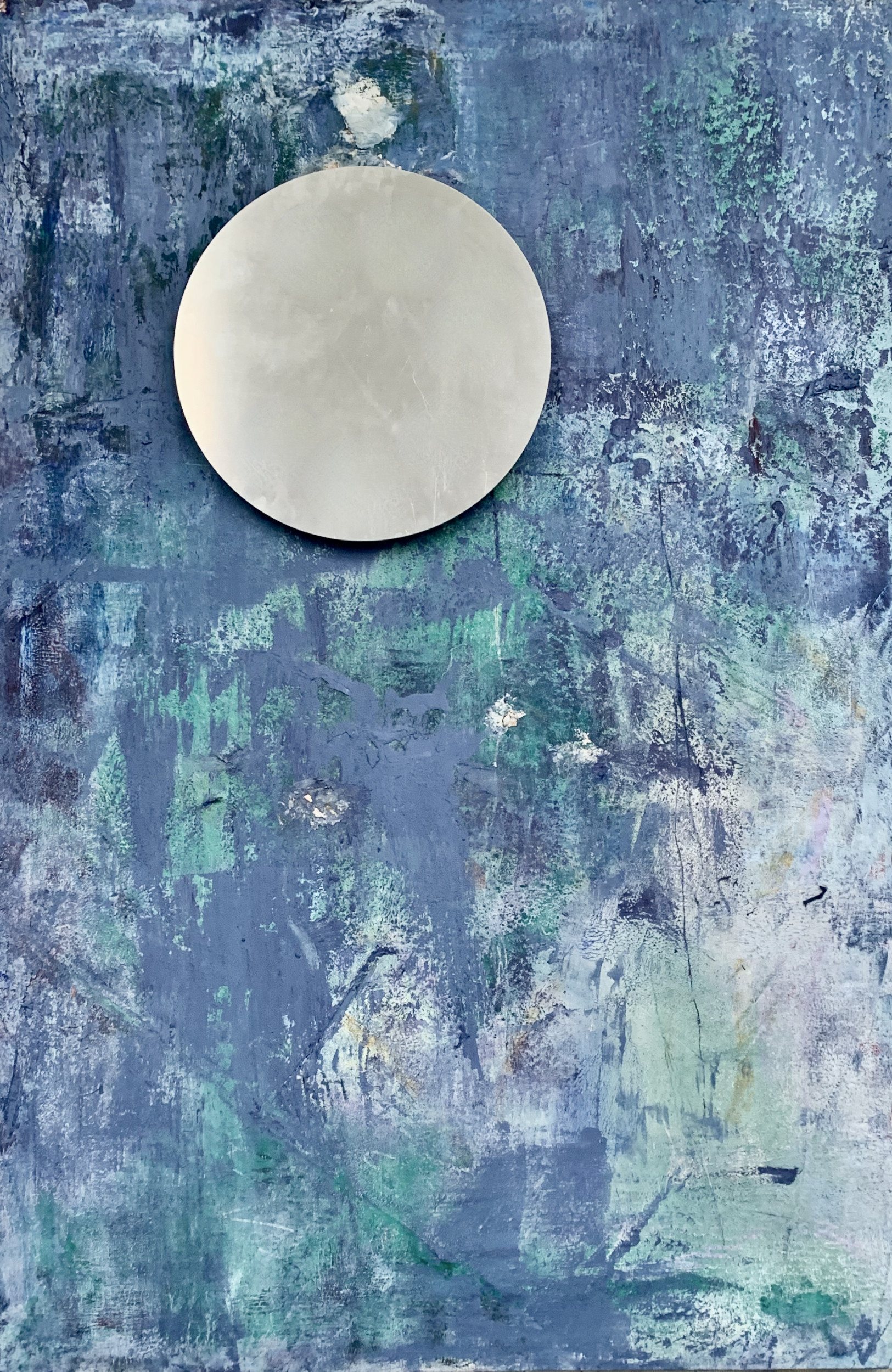
This series of paintings concerned the impermanence of life and the certainty of change.
They were inspired by megalithic court cairns I had seen in North Mayo. I worked on most of them during COVID. This feels like a time when our world is hurling itself and ourselves through a whirlwind of change. These paintings refer to the ancient monuments dotted across the landscape of Ireland.
They were erected at another time of transition. The elegant structures, now covered in moss and lichen, are weather-worn witnesses to passing millennia. These stones, powerfully moulded, retain an intensity that is appropriate to the many magical meanings that have been attributed to them. Together with the tumult of lockdowns, these structures, and their position in the landscape over millennia, inspired these paintings.
Your paintings can range from huge landscapes to small, detailed studies – which do you prefer?
As an eminently pragmatic person, I’d much prefer to paint only on a small scale. It would be wonderful to have all my paintings manageable and the size of postcards. But I would miss the opportunities provided by scale.
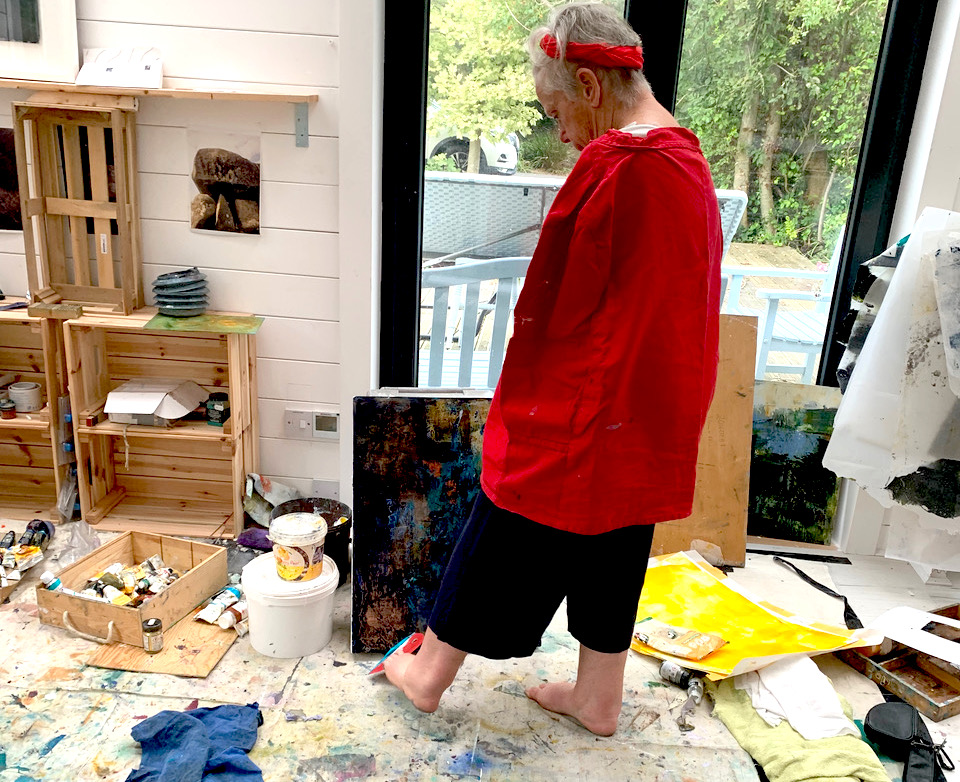
I choose to use large support which are usually very heavy as well. I do this because of the way I use my body. I want to be able to make big gestures, and large, wide sweeps. So, both little and large surfaces are essential to my practice. I really need both.
What challenges have you had to overcome in your career as an artist?
I have heard myself being spoken about in loud voices, as if I cannot understand the comments that they make among themselves about me.
As an artist painting among other artists, I’ve been singled out to have had coins thrown at me in the street. I have heard myself being spoken about in loud voices as if I cannot understand the comments, they make among themselves about me.
This experience of condescension from non-disabled people is hard to bear. Such behaviour is considered rude by most people who forget their manners when in the company of disabled people like me.
Getting over this has been my biggest challenge.
Eventually, it occurred to me that people who like my paintings don’t care about how I painted them. The people who are condescending and overawed about “what she can do with her feet” are not in the least bit interested in my paintings.
You’ve pioneered a variety of art forms – photography, performance art, among others – what keeps you thriving to create?
I like communicating. I like making things, fixing things. And being born without arms makes this a huge challenge. So, being an artist, even with my limitations, it allows me to be that person – she who likes to make and create. It is simply part of who I am.
The theme of This Is Art! 2023 is "Inspiration" — have you any tips or tricks for young artists who might struggle with "inspiration" or who say, "I just can't get inspired."
The creative process doesn’t happen in a vacuum. It requires determination and commitment, as well as being open, willing and active. These things are important, but so is a food plan. Getting hungry while painting is a big barrier for me, so I try and make my lunch and dinner first, so they are ready when I want to, or must, stop and eat.
I might never get anything done if I hadn’t a plan for finishing. Have to clean my feet and cook is a barrier to getting started so I do that first. Then I clear my mind to do the work.
It is my experience that inspiration (as referred to in your question and your theme) is mostly an indulgence created by people who much in their heads are too much. They’re often dreaming of all the things they could do if they could just get out of the habit of avoidance.
For example, some artists tell me they are motivated by watching YouTube videos of other people painting. I don’t think that would help me much — as far as I can see I’d just watch more and more videos.
So, I recommend doing something active to support the intention of being creative: get up, move about, dance, clean up, tidy your art supplies. Cleaning up work for me if I don’t feel like painting. It gives me ideas. If I was to wait for inspiration, I would never get anything done. My biggest tip is don’t forget to prepare your lunch first.
Does inspiration happen to you like a lightbulb over your head like you see in cartoons?
I have loads of light bulb moments... especially early in the morning. It is really hard to ‘capture’ them appropriately. By that I mean, not be jumping from one idea to the next. It is hard to keep focussed on say, writing a report while I have a hundred ideas an hour banging around my head trying to get my attention away from what I am trying to finish. I mostly fail.
But I have a new practice where I try and consciously write them down while I am drinking my tea in those first 30 mins of quietness. As the day goes on I can add to it, rather than keep switching from one task to another. I call it a Brain Bin.
Do you think people are 'born' artists?
I think everyone is creative and the journey of life is to find out how to express that innate creativity.
If you can arrange a bunch of flowers satisfactorily you have the necessary potential to create visual images. Not everyone can do this. But there is a lot more to being a professional artist than just making pictures.
But if you don’t understand how to make tulips look good in a jam jar, I think you’ll struggle with the visual arts. In that case, consider writing, music or dance. There are lots of ways to be creative.
What advice would you give anyone who wants to be professional artist, or pursue a career in the arts?
This may sound strange, but if you chose to work as a professional artist, I think three things are important:
1. Being able to be your own critic. Be able to assess your own work and that of others.
2. Know the value of your work and treat it with respect. Set up a realistic pricing structure based on reality of your costs and the market, and then stick to it. Avoid a situation where you are dependent on selling paintings to eat - a situation where your price changes according to how hungry you are. I know this is hard, but being a desperate artist is not inspiring to collectors.
3. Be willing to engage in the ‘business’ of art. Today more than ever, participating in social media, managing a website, dealing with grants and gallerists, meeting collectors as well as writing about your work is a huge part of the being an artist. It takes huge effort and many skills to be able to do this effectively. I know because while I have a variety of skills, I’m not great at this myself. I am just not willing to do all the work, even though I know I have aptitude. So, the business of art is not for everybody. But if you have the skills and determination to engage in the business side of art, well I reckon you are half the way there, at least.
Any advice for young artists who might think their work is "no good"?
Congratulate yourself on your honesty and perceptiveness because it probably is not any good… yet. It takes time and that’s not surprising. It takes effort and hours to develop any skill. The skills needed in art are no different from architecture, plastering, bricklaying, veterinary, accounting, or learning to play the piano.
It amazes me the number of people who expect to be really good at art after one class or two. One poster in a Dublin art shop advertised… “Come and learn to paint in one weekend and go home with two framed paintings. No skill or experience required.“
There is the perception that art is acquired differently from other skills and that artists are born with a talent and emerge fully formed. I think we can agree nobody could learn to type or become a bricklayer in the weekend and be a professional at the end of it. So why should art be any different?
Learn to appraise your work by asking important questions. Like is it balanced appropriately? Are there a variety of shapes? Is there a good range of tones and colour? One way to check the variety of tones is to take a photo of your painting on a mobile phone. Use the photo app on the phone to reduce the colour of the painting to black and white. If it’s a good painting it should look good in black and white as well as colour.
If it is a painting or drawing, looking at it in a mirror will help you see it in a different way and any faults will stand out clearly.
How do you challenge yourself creatively?
Every month I try and do something that takes me out of my comfort zone. Whether that is learn about making reels for Instagram, or go to an event like speed curating, or an artist’s talks organised by networks like the Visual Artists Association of Ireland.